A laser session can be appropriate after some athletic injuries, but timing depends on the diagnosis, tissue damage, skin sensation, swelling and medical risk. You will learn how to recognise injuries that need urgent assessment, what a safe treatment plan includes, and when pain relief is not evidence that you are ready to train.
Key takeaways
- Get an injury assessment before applying Class 4 laser therapy.
- Use laser therapy as part of rehabilitation, not a replacement for loading.
- Follow your clinician’s advice before training or competing after treatment.
- Continue treatment only when measurable progress justifies the time and cost.
When is it safe to use Class 4 laser after an injury?
Class 4 laser therapy for athletes should follow an assessment, not happen automatically at the injury site. A clinician may consider it for a muscle strain, selected tendon injury, ligament sprain, joint pain, contusion, or post-operative rehabilitation after the surgeon permits treatment.
The decision depends on the diagnosis, timing, skin condition, sensation, circulation and rehabilitation plan.
Acute inflammation is not an automatic ban. Marked swelling, bleeding or an uncertain diagnosis changes the priority from symptom treatment to protection, examination and referral. Laser may reduce symptoms, but it cannot rule out structural injury or justify delaying emergency care.
Seek urgent medical evaluation for:
- Suspected fracture, dislocation, complete tendon or ligament rupture, or compartment syndrome
- Infection, fever, uncontrolled bleeding or an open wound
- Rapidly increasing swelling or pain, visible deformity, or inability to bear weight
- Numbness, loss of sensation, weakness, or changes in skin colour or circulation
Do not use a laser session to test whether these problems are serious. Once urgent conditions are excluded, a qualified clinician can decide whether treatment fits the tissue and stage of recovery, then combine it with protection, appropriate loading and rehabilitation.
Pain relief alone does not prove that the injury has healed or that you are ready to train.
What can laser therapy add to sports-injury rehabilitation?
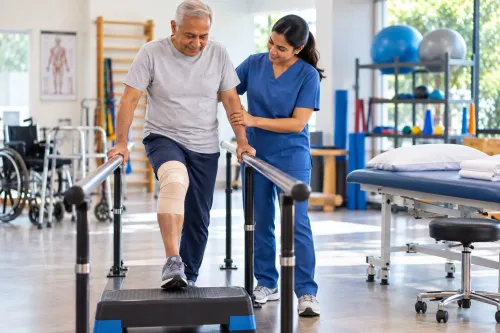
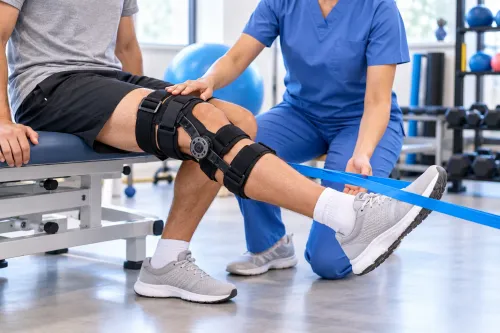
Laser therapy for sports injuries is an adjunct: it may reduce short-term pain or improve tolerance of rehabilitation, but it does not replace diagnosis or rebuild injured tissue. Function and tissue capacity come from relative protection, load management, progressive mobility, strength work and sport-specific drills.
“Laser” can mean low-level photobiomodulation, high-power Class 4 treatment or surgical laser. Wavelength, output mode and dose matter; Class 4 describes a hazard category, not superior effectiveness.
| Option | Main role | Poor fit or limitation |
|---|---|---|
| Ice and compression | Early swelling and symptom control | Do not use them as a substitute for assessment when swelling rapidly increases |
| Medication | Medically appropriate pain control | Do not self-medicate to mask pain during loading |
| Therapeutic exercise | Restores strength, capacity and function | Do not force exercise through an unstable injury |
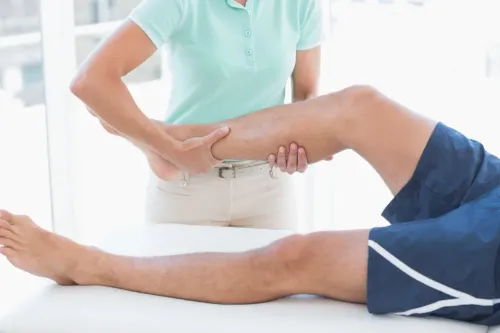
| Manual therapy | Selected mobility or pain goals | Do not treat over an unassessed fracture |
| Ultrasound | Narrower, condition-specific clinical indications | Do not choose it simply because pain needs a device |
| EMTT or focused/extracorporeal shockwave therapy | Different tissue and problem profiles | Do not apply shockwave over an acute tear or prohibited post-operative area |
Reduced pain can mislead you into loading a partly healed tendon, muscle or ligament too soon.
Use pain and movement gains to participate in a graded plan, not to clear yourself for sport; if pain, function or rehabilitation participation does not measurably improve after a defined trial, reassess the diagnosis and plan rather than increasing the laser dose indefinitely.
What happens during a Class 4 laser treatment session?
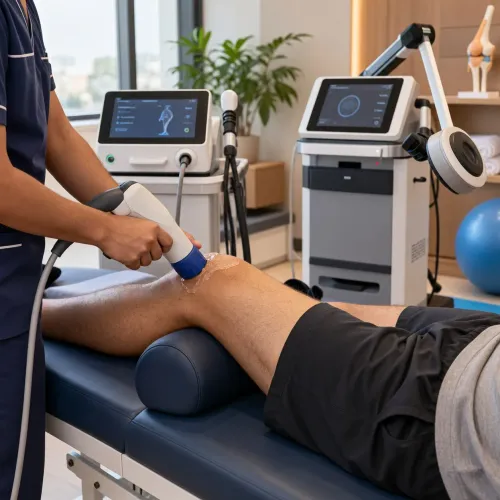
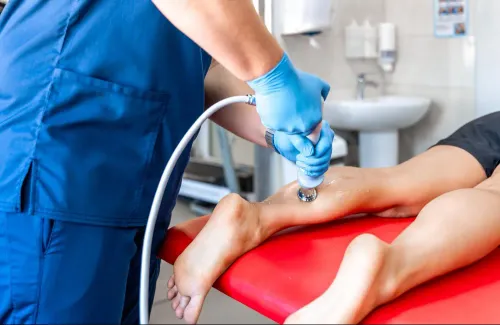
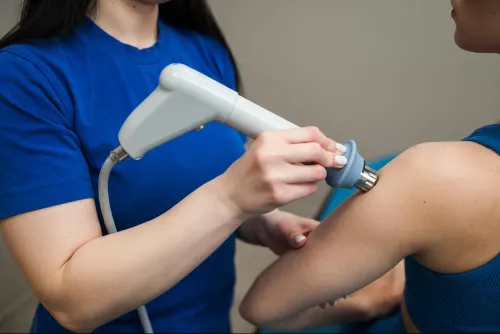
A session starts with history and examination, not automatic application to the painful spot. The clinician confirms the diagnosis and injury classification, checks symptom duration, swelling, skin integrity, sensation, circulation, tissue depth and training demands, then selects the treatment area.
Before treatment, disclose:
- Photosensitising medicines; cancer or suspected malignancy; pregnancy near the area; thyroid or reproductive-organ exposure; light-triggered seizures
- Impaired sensation, poor circulation, active bleeding, infection, or an implanted or active medical device
- Post-operative restrictions set by your surgeon
Suspected fracture, dislocation, complete tendon or ligament rupture, compartment syndrome, deformity, rapidly increasing swelling or pain, fever, numbness, weakness, or skin-colour and circulation changes require referral rather than laser treatment. These referral conditions are separate from device-specific precautions.
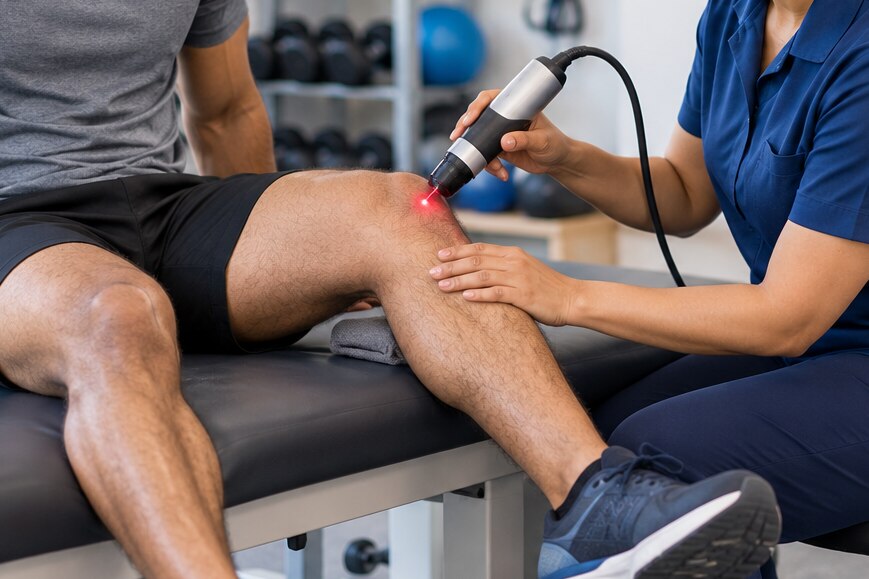
The clinician records wavelength, power, spot size, mode, treatment time, energy density and treatment frequency. Class 4 identifies a laser hazard category, not superior effectiveness. A trained clinician controls access, uses wavelength-appropriate eye protection, prevents direct or reflected exposure, avoids reflective surfaces, and moves the applicator while monitoring heat and pain.
The dose response is biphasic: more energy is not automatically better. Superficial or poorly perfused tissue, especially with reduced sensation, has greater burn risk.
After treatment, the clinician reassesses pain and function. A suitable response supports rehabilitation; it does not prove the injury has healed or clear you to train.
Can you train or compete after the session?
Moving warmth or mild tingling during laser physiotherapy for injury recovery can be normal. Sharp pain, excessive heat, persistent redness or burning is not: ask the clinician to stop the application and inspect the area. Pain relief does not prove the tissue has healed, so same-day training or competition is not automatically safe.
Use the injury diagnosis and function-based criteria before increasing load:
- Pain-controlled, near-normal range of motion
- Strength that meets the clinician’s comparison or testing target
- Hopping or landing without unacceptable pain, swelling or instability
- Controlled acceleration and deceleration
- Cutting or change-of-direction tasks when relevant
- Sport-specific drills completed without deterioration
For a defined trial, such as one week or a planned set of rehabilitation sessions, record pain, swelling, movement, strength and participation in rehabilitation. If those measures do not improve, reassess the diagnosis and treatment plan rather than increasing the laser dose indefinitely.
Evidence for Class 4 laser is stronger for short-term symptoms and recovery measures than for guaranteed faster healing or return to sport. Wavelength, applicator, power and dose differ between devices, so results from one protocol cannot automatically be transferred to another. Treat the session as an adjunct, not clearance to play.
How should you decide whether a laser plan is worth continuing?
Continue only when the plan has a measurable purpose, not because the machine is available. Class 4 laser therapy for athletes is worth reviewing if it improves pain, loading tolerance, movement or rehabilitation participation during a defined trial; it is not proof of faster healing or a return-to-play date.
Ask the clinician to document:
- The diagnosis and intended target tissue.
- The device’s exact wavelength, output mode, dose and session duration.
- The planned number and frequency of sessions.
- Safety screening, including sensation, circulation, medicines and surgical restrictions.
- The exercises that address mobility, strength and tissue capacity.
- Return-to-sport milestones, such as full movement, strength testing, hopping, cutting or sport-specific drills.
- The review date and the action if progress stalls.
Laser physiotherapy for injury recovery should sit beside rehabilitation, not replace it. Back In Motion -Dr. Sajal Agarwal -Physiotherapist is a Delhi option where athletes can ask for laser to be considered alongside examination, exercise progression and return-to-sport planning.
| Decision point | Continue the plan | Reconsider the plan |
|---|---|---|
| Goal | A defined movement or loading task improves | No measurable change after the agreed trial |
| Symptoms | Pain or swelling supports exercise participation | Relief is brief, worsening or masks overload |
| Diagnosis | Findings remain consistent with the original injury | New weakness, swelling, instability or unexplained pain appears |
Athletes can receive Class 4 treatment after injury when a qualified clinician confirms that the injury and safety profile fit the protocol; it is an adjunct, not clearance to play.
Related services
Class 4 Laser Therapy at Dr. Sajal Agarwal Physiotherapist - Back in Motion At Back in Motion, we are proud to offer the advanced Class 4 Laser Therapy, a cutting-edge... View service → |
Sports Injuries Treatment at Dr. Sajal Agarwal Physiotherapist - Back in Motion At Back in Motion, we specialize in the rehabilitation and treatment of sports... View service → |
Frequently asked questions
When is it safe to use Class 4 laser after an injury?
Use it after a clinician assesses the injury and confirms that laser treatment is appropriate. For post-operative recovery, wait until the surgeon permits treatment.
What can laser therapy add to sports-injury rehabilitation?
It can support a broader rehabilitation plan for selected muscle, tendon, ligament, joint, and contusion injuries, alongside exercises and load management.
What happens during a Class 4 laser treatment session?
A clinician reviews the injury, selects treatment settings, positions the applicator over the target area, and monitors your response during treatment.
Can you train or compete after the session?
Do not assume you can return immediately. Follow the clinician’s guidance and base training or competition decisions on pain, movement, strength, and injury-specific loading tests.
How should you decide whether a laser plan is worth continuing?
Track pain, range of motion, strength, training tolerance, and function. Continue when objective progress supports the treatment; reassess the plan when progress stalls.
Keywords