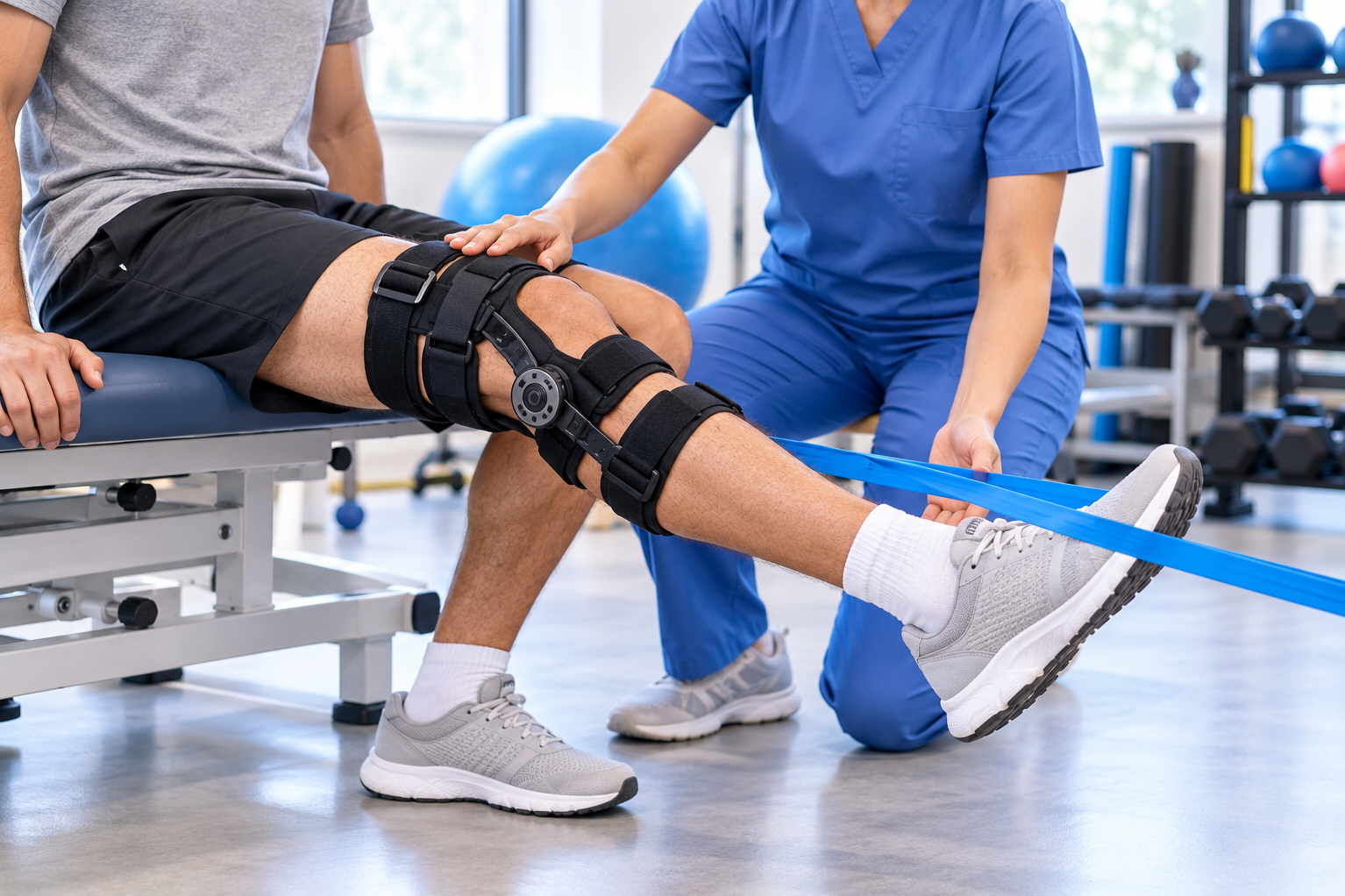
An ACL injury can affect knee stability, confidence, walking, running, and participation in sport. Some injuries are managed through structured rehabilitation, while others require reconstruction followed by post-operative physiotherapy.
ACL injury and ligament tear rehabilitation in Rohini should be based on examination findings, medical guidance, activity goals, and measurable progress. Time since injury is important, but it should not be the only factor determining return to activity.
The Early Phase Focuses on Knee Control
After an acute ligament injury, the knee may be painful, swollen, and difficult to straighten. The person may walk with a limp or feel that the knee is giving way.
Early rehabilitation may focus on:
- Managing swelling
- Restoring knee extension
- Gradually improving flexion
- Activating the quadriceps
- Improving walking
- Protecting healing structures
- Maintaining hip and ankle function
Patients who undergo surgery should follow the surgeon’s precautions and rehabilitation protocol.
Strength Must Be Rebuilt Systematically
ACL injury commonly affects quadriceps strength. Weakness may persist even after pain and swelling decrease, making structured strengthening essential.
Exercises can progress from basic muscle activation to squats, step exercises, resistance training, single-leg work, running preparation, and sport-related movements.
The progression should reflect control and tolerance. Adding jumping, cutting, or pivoting before the knee has adequate strength can expose the patient to unnecessary risk.
Balance and Coordination Matter
Ligament injuries can affect the body’s awareness of joint position. Rehabilitation therefore includes balance, coordination, and neuromuscular control.
Later exercises may challenge the patient to stabilise the knee during single-leg tasks, direction changes, landing, or unexpected movement. Athletes need training that resembles the demands of their sport rather than only completing clinic-based strengthening.
Readiness Cannot Be Judged by Time Alone
Returning to sport simply because six or nine months have passed is not enough. The decision should consider symptoms, movement quality, strength, functional testing, psychological readiness, and medical clearance.
Readiness indicators may include:
- Minimal or no swelling
- Full or near-full movement
- Good quadriceps and hamstring strength
- Controlled single-leg movement
- Safe landing mechanics
- Ability to run without adverse response
- Successful completion of sport-specific drills
- Confidence in the knee
The exact criteria depend on the sport, injury, and treatment route.
Common Mistakes During ACL Recovery
Stopping rehabilitation after normal walking returns is a major mistake. Walking comfortably does not demonstrate readiness for running, jumping, or competitive sport.
Other avoidable errors include:
- Progressing according to pain alone
- Ignoring persistent swelling
- Comparing recovery timelines with other patients
- Skipping strength testing
- Returning directly to matches
- Neglecting the uninjured leg
- Avoiding challenging movements indefinitely
A gradual return-to-training phase helps bridge the gap between rehabilitation and unrestricted participation.
Choosing Rehabilitation Support
Patients should look for a physiotherapist who understands orthopaedic and sports rehabilitation, communicates with the treating surgeon when needed, and uses objective progress markers.
Back In Motion, Dr. Sajal Agarwal, Physiotherapist, provides ACL injury and ligament rehabilitation in Rohini, Delhi. Treatment planning can include progressive strengthening, balance work, movement retraining, and preparation for everyday or sporting demands.
ACL injury and ligament tear rehabilitation in Rohini should restore more than knee movement. A complete programme rebuilds strength, control, confidence, and the capacity to manage real-world activity. Returning only after appropriate testing and progression gives patients a safer foundation for work, exercise, and sport.
Keywords