The better setting depends on what the person can safely practise, how much supervision is needed, and whether the home supports recovery. By comparing clinic treatment, structured home exercises and a combined plan, you can choose an approach that matches the stroke stage, functional goals, caregiver support and risks rather than relying on a generic exercise list.
Key takeaways
- Choose the setting that supports safe, consistent practice.
- Use professional assessment before starting difficult home exercises.
- Match treatment to the stroke recovery stage and your home layout.
- Track walking, balance, strength and daily-task progress every week.
The Better Choice Depends on Safety, Participation and the Home Setting
Neither setting is automatically more effective: the better choice depends on safety, reliable participation and the home setting. The phrase “stroke physiotherapy or home rehabilitation which is better” frames a false either-or. Home rehabilitation after stroke means exercises completed by the patient or caregiver; a physiotherapist’s home visit is supervised treatment delivered in the home.
| Option | Best fit | What it delivers |
|---|---|---|
| Clinic physiotherapy | Close observation, specialist equipment, intensive gait or balance practice, or unstable medical problems | Higher-risk training and therapist monitoring |
| Home rehabilitation | Reliable participation and practical household goals | Bed-to-chair transfers, bathroom movement, stairs and walking across household surfaces |
| Combined plan | Needs that change across settings | Clinic assessment and higher-risk work, plus structured home practice |
A combined plan often works best: use a clinic for assessment and higher-risk training, practise structured tasks daily at home, and add a home visit or video review when needed. A short, irregular clinic programme is not automatically better than consistent home practice.
Aim for meaningful, needs-based practice on most days when you are medically able and willing.
Match the Setting to the Stage of Stroke Recovery
Rehabilitation should become more challenging as safety and function improve, not repeat the same exercises after discharge.
In hospital, physiotherapy after stroke must be medically coordinated. Very early mobilisation is not the same as pushing high-dose walking during the first 24 hours; aggressive early mobilisation can worsen outcomes for some patients.
After discharge, early supported home rehabilitation after stroke is suitable only when:
- Health is stable.
- The home layout allows safe movement.
- The person participates reliably.
- Someone can support transfers and exercises.
Begin with practical control rather than distance. Prioritise:
- Positioning and bed mobility
- Sitting balance
- Sit-to-stand practice
- Bed, chair and toilet transfers
- Standing
- Short, supervised walking
As strength and balance improve, add stairs, uneven surfaces, community walking, dressing, reaching and use of the affected arm during daily tasks. Long-term maintenance should preserve range of motion, walking capacity, strength, confidence and independence after formal sessions finish.
Clinic treatment becomes valuable for higher-intensity gait training, graded equipment, close supervision and reassessment when progress stalls. Home practice remains essential because recovery depends on safe repetition between appointments, not session counts alone. The best setting can therefore change with the person’s stage, risks and goals.
Compare Clinic Physiotherapy and Home Practice by What You Can Deliver
The question “stroke physiotherapy or home rehabilitation which is better” depends on what you can deliver safely and repeatedly. Home rehabilitation means exercises completed by you or a caregiver; a physiotherapist home visit is supervised treatment in your own environment. Physiotherapy after stroke works best when the setting matches the task and risk.
| Option | What it delivers | Main trade-off |
|---|---|---|
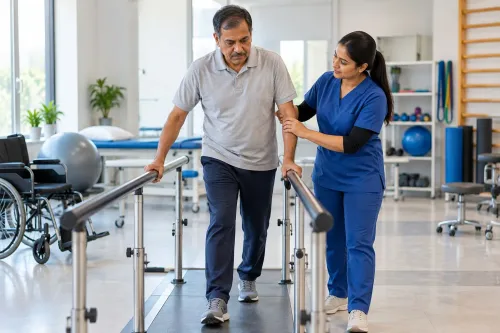
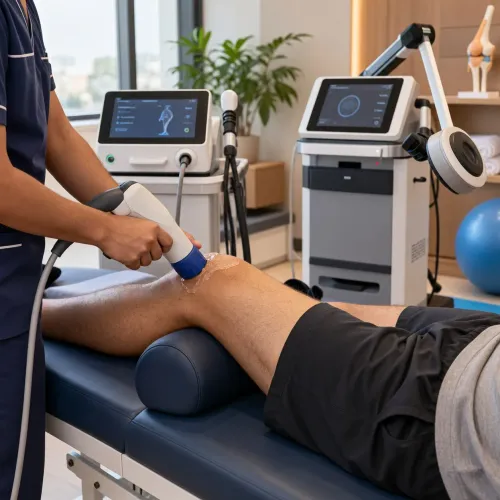
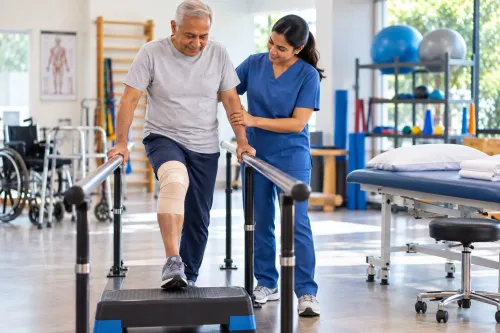
| Clinic-only | Therapist observation, parallel bars, treadmills or graded equipment where appropriate, plus controlled walking, transfers and upper-limb practice | Travel can increase fatigue, and the clinic cannot reproduce loose rugs, narrow bathrooms, bed height, stairs or poor lighting |
| Home-only | Real household transfers and walking, with easier repetition across the day | Requires reliable participation, suitable space and a caregiver who can assist within taught limits rather than lift or complete every task |
| Combined | Clinic assessment and higher-risk training, structured home practice, and home visits or reviews when needed | Requires coordination, but often provides the most usable practice |
Choose home-only treatment only when support makes transfers and exercises safe. A written programme should name the functional task, repetitions or time, rest periods, assistance level and progression rule.
Record walking distance or speed, transfer assistance, falls, pain, arm use and personal-care independence at baseline and review points. Telerehabilitation can support follow-up when camera positioning and communication are reliable, but it cannot replace hands-on assessment of transfers, tone, joint movement or home hazards.
Know When Home Exercises Need Professional Assessment First
Do not exercise through new weakness, facial drooping, speech or vision changes, sudden confusion, severe headache, or suspected recurrent stroke. Stop and seek prompt stroke-team or medical assessment instead.
| Situation | Safer decision | Why |
|---|---|---|
| Repeated falls, worsening balance, severe weakness, neglect or uncertain cardiac status | Professional review before increasing walking intensity | The prescribed effort and supervision may need adjustment |
| Shoulder pain, a painful or stiff joint, new spasticity or skin problems | Pause progression and request assessment | More exercise can worsen pain, contracture or tissue injury |
| Marked fatigue, chest symptoms, swallowing difficulty, communication barriers or cognitive problems | Obtain medical or wider stroke-team review | You may not recognise danger signs or follow instructions safely |
During home rehabilitation after stroke, never pull the affected arm by the hand or lift it from the shoulder during transfers. Support the person as taught.
Constraint-induced movement therapy belongs in a suitable physiotherapy after stroke plan only when the person has active wrist and finger movement, adequate sensation and safety awareness. Do not restrain the stronger arm when voluntary control, balance or judgement is inadequate.
Caregivers should learn positioning, transfer technique, cueing, assistance limits and stopping signs. They provide trained support, not untrained therapy. A professional should assess walking before progression when balance is poor, weakness is severe or heart status is uncertain.
Build a Measurable Plan When Comparing Stroke Rehabilitation in Delhi
Choose the pathway that makes safe, measurable practice possible, not the one attached to a particular Delhi neighbourhood. The same standard applies when comparing stroke physiotherapy Rohini with another provider or setting.
| Option | What it means | When it applies |
|---|---|---|
| Clinic assessment | Therapist observes movement and uses equipment for higher-risk practice | Severe weakness, poor balance, neglect, uncertain cardiac status or intensive gait work |
| Home rehabilitation | Patient or caregiver repeats prescribed tasks at home | Safe participation, reliable support and goals involving transfers, stairs or bathroom movement |
| Hybrid pathway | Clinic assessment and challenging practice plus daily home repetition and selected home visits | A practical fit for many people seeking stroke rehabilitation in Delhi |
Use this checklist before committing:
- Ask about neurological-stroke experience and whether assessment happens in the chosen environment.
- Require goals such as walking 20 metres, reducing transfer help or dressing independently, with baseline measures and review dates.
- Confirm the plan covers the affected side, strength, sensation, vision or neglect, cognition, communication, fatigue, stairs, bathroom access, home layout and available support.
- Ask for exercise dosage: repetitions or minutes, rest periods, assistance level and progression rule.
- Confirm caregiver training for cueing, positioning, transfers and stopping signs.
Back In Motion -Dr. Sajal Agarwal -Physiotherapist may be relevant if you are comparing clinic assessment, structured home practice and supervised home visits; judge the option by safety and goals. Review when progress stalls or symptoms change.
Neither setting wins for everyone; the most effective plan is the safest one that delivers meaningful, repeated, measurable practice.
Related services
Physiotherapy for Strokes Physiotherapy for Stroke Recovery at Dr. Sajal Agarwal, Physiotherapist, Back in Motion Reclaim Your Life with Professional Stroke Rehabilitation... View service → |
Physiotherapy for Paralysis at Dr. Sajal Agarwal Physiotherapist - Back in Motion At Back in Motion, we offer specialized physiotherapy for paralysis, helping individuals regain... View service → |
Frequently asked questions
Is stroke physiotherapy or home rehabilitation more effective?
Neither is automatically better. The right choice depends on safety, participation, supervision and whether your home supports the exercises.
When is clinic physiotherapy preferable after a stroke?
Choose clinic treatment when you need specialised equipment, close supervision, challenging balance work or assessment of movement problems.
When can home rehabilitation after stroke work well?
Home practice works when exercises are safe, the patient and caregiver can follow instructions, and the home allows regular repetition.
Should a physiotherapist assess you before starting home exercises?
Yes, especially after a recent stroke, falls, severe weakness, poor balance, pain or difficulty understanding instructions.
How do you compare stroke rehabilitation in Delhi?
Compare safety, supervision, travel demands, home conditions and measurable goals such as walking distance, transfers and daily activities.
Keywords