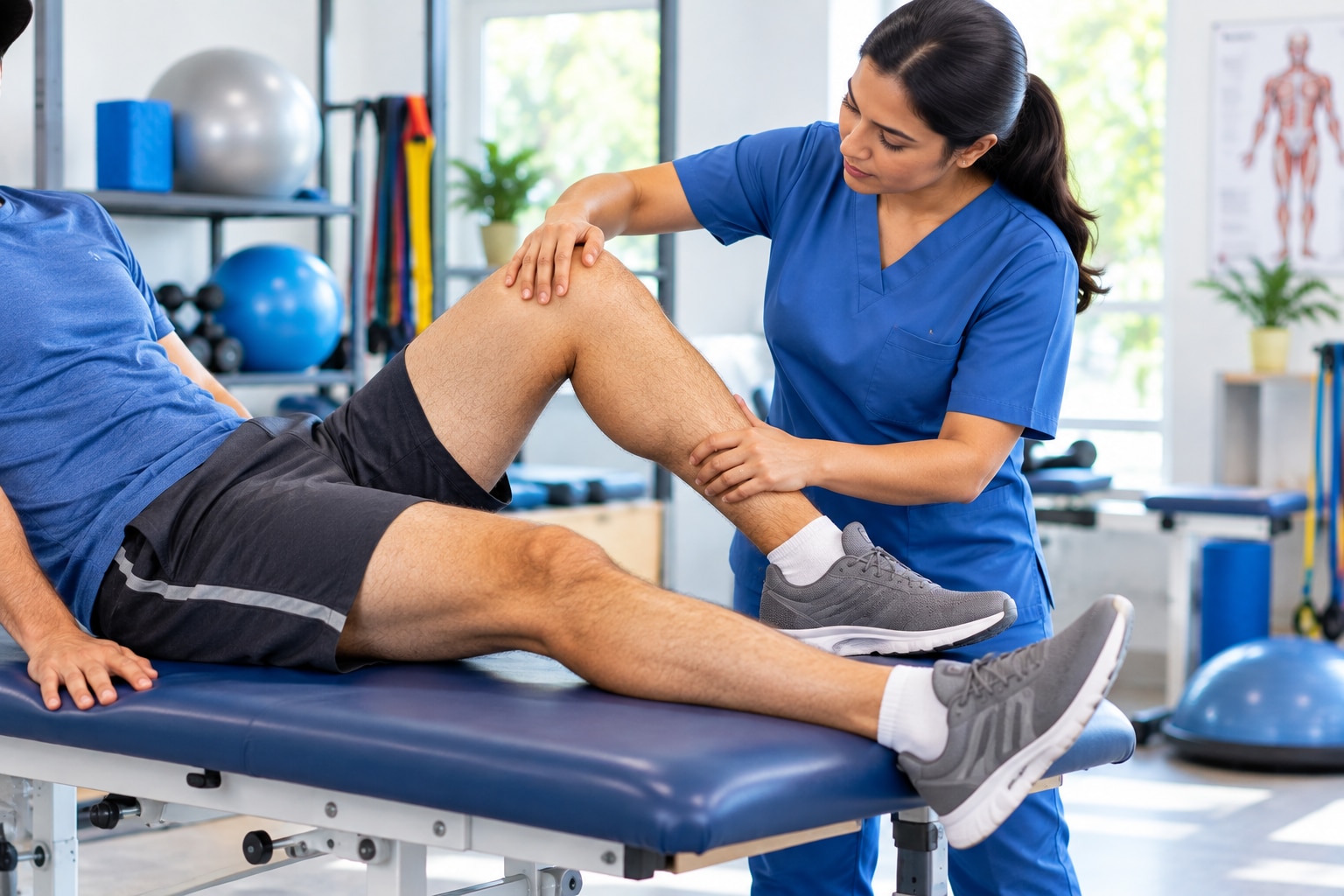
Complete rest is useful for a serious injury, but it is the wrong default for many uncomplicated strains and sprains. You will learn how to choose relative rest, active recovery or urgent assessment, then judge readiness for sport using symptoms, strength, movement and sport-specific tasks.
Key takeaways
- Use relative rest, not bed rest, for most uncomplicated sports injuries.
- Protect the injury for 24 to 72 hours while keeping comfortable movement.
- Match loading exercises to symptoms before returning to sport-specific training.
- Progress by pain, strength and function rather than a fixed recovery date.
The fastest recovery usually starts with relative rest, not bed rest
For most uncomplicated sports injuries, choose relative rest followed by graded rehabilitation—not bed rest and not immediate return to training. So, sports injury physiotherapy or rest which is better? Neither alone: stop the activity that causes sharp or escalating pain, keep comfortable movement, then rebuild strength and sport-specific tolerance.
| Option | What it means | When it applies |
|---|---|---|
| Complete rest | Immobilise the area and stop loading it | Suspected fracture, dislocation, complete rupture or serious concussion until assessed |
| Relative rest | Stop aggravating activity while maintaining pain-free movement and safe conditioning | Mild strains, sprains and early tendon irritation |
| Physiotherapy | Examination, symptom-guided exercise, strengthening and return-to-sport loading | Symptoms limit movement, recur with training or fail to improve |
Complete rest can quickly reduce strength, joint motion and confidence. Loading too hard can prolong swelling and pain. A physiotherapist can track range of motion, strength, swelling, hopping or running tolerance, and next-day symptoms before increasing demand.
Seek urgent medical evaluation for a visible deformity, inability to bear weight, major swelling, joint locking, repeated giving-way, focal bone pain or suspected fracture. After a head impact, do not return to play the same day; concussion symptoms need medical assessment and a supervised progression.
Pain alone does not prove that an injury is ready for sport.
What to do during the first 24 to 72 hours
Stop the sport, drill or exercise that produces sharp, increasing or compensatory pain. Rest after sports injury means relative rest: reduce the aggravating load without spending the day motionless, because complete inactivity quickly reduces strength and joint range.
Use this checklist for the first 24 to 72 hours:
- Stop sprinting, jumping, cutting, heavy lifting and contact play if they reproduce symptoms.
- Keep gentle, pain-limited movement in nearby joints, such as relaxed range-of-motion exercises or an easy walk when you can walk normally.
- Maintain conditioning only through activities that do not increase pain, swelling, limping or altered technique during the session.
- Recheck the injury later that day and the next morning. A clear increase in pain, swelling or stiffness means the previous load was too high.
- Seek urgent medical evaluation for visible deformity, suspected fracture, inability to bear weight, rapidly expanding swelling, joint locking, repeated giving-way, severe unremitting pain, or an audible snap followed by loss of strength or function.
- Treat numbness, tingling, or a cold, pale or blue limb as an emergency.
A blow to the head changes the plan. Do not return to play on the same day after suspected concussion; arrange medical assessment, then follow a supervised progression with at least 24 hours at each stage. Stop and step back if symptoms return.
Match the symptom pattern to the injury before you load it
The symptom pattern determines whether you need relative rest, prompt assessment, or staged rehabilitation—not a blanket rest-versus-physiotherapy choice.
| Injury type | Clues | Rest and rehabilitation |
|---|---|---|
| Muscle strain | Sudden pain during sprinting, lifting or stretching; tenderness in the muscle | Stop painful loading briefly, then restore movement, strength and running gradually. |
| Ligament sprain | Joint pain, swelling, bruising or giving-way after a twist | Mild sprains need protected movement and progressive strengthening; severe instability needs examination and possible bracing. |
| Tendon irritation | Localised pain that builds with repeated loading, such as jumping or gripping | Reduce the provoking load, then rebuild tendon capacity with gradual resistance. Complete rest alone often leaves it weak. |
| Stress injury | Focal bone pain that worsens with impact and may persist at rest | Stop running or jumping and arrange assessment; continuing impact can turn a small stress injury into a fracture. |
| Dislocation | Visible deformity, a joint stuck out of position or immediate loss of function | Seek urgent medical care. Do not try to relocate it yourself; rehabilitation follows reduction and medical clearance. |
| Fracture | Point tenderness, deformity, severe swelling or inability to bear weight | Treat as a medical injury requiring imaging, protection or immobilisation before rehabilitation. |
Seek urgent assessment for numbness, a cold or pale limb, rapidly increasing swelling, an audible snap followed by lost function, or severe pain. Persistent focal pain, repeated giving-way or worsening symptoms also warrants examination before loading.
Build back through measurable stages instead of a calendar date
Do not progress because a certain number of days has passed. Progress when the injured area tolerates the next demand without increased pain, swelling, stiffness or loss of function during exercise or the following day. A pain-free walk is only a baseline.
1. Leave pain-control work when you can perform daily movements and basic strengthening with symptoms staying stable. You should not limp, protect the joint, or worsen overnight.
2. Build capacity when range of motion is near equal to the uninjured side and strength is comparable on appropriate tests. Complete repeated movements, such as calf raises, squats or single-leg balance, without sharp pain, giving-way or compensatory movement.
3. Add sport-specific tasks in order: jogging, acceleration, deceleration, jumping, landing, change of direction and repeated efforts. A low-load gym exercise can feel easy while sprinting or cutting still exceeds tissue capacity.
4. Return to unrestricted sport after completing a demanding training session that matches your sport’s speed, volume and contact requirements, with no significant swelling, pain increase or next-day decline. If a measure deteriorates, reduce the load and repeat the previous stage.
For a suspected concussion, use a separate supervised progression. Do not return on the same day; advance through stages at least 24 hours apart and step back if symptoms recur.
How to choose sports injury care in Rohini or Delhi
Choose the clinic that measures your recovery, not just your pain. Compare sports injury physiotherapy Rohini, sports injury treatment in Delhi and athlete rehabilitation Rohini by asking for a documented assessment, progressive home programme, scheduled reassessment and clear return-to-sport criteria.
A service offering only massage, electrotherapy or temporary pain relief cannot show whether you can sprint, land, decelerate or change direction safely.
Ask these questions before booking:
- What tests will you use to identify the injured tissue and establish a baseline?
- Which exercises can you do at home, and how will you progress their load?
- What will you need to achieve before running, training, contact or competition?
- When will you refer me for imaging or medical assessment?
If you compare Back In Motion -Dr. Sajal Agarwal -Physiotherapist with another clinic, use these questions rather than choosing by location alone.
| Comparison point | Strong care | Warning sign |
|---|---|---|
| Assessment | Records strength, range, swelling, movement and sport demands | Starts treatment without examining you |
| Progression | Advances from safe movement to strength, speed, cutting and sport-specific drills | Repeats the same passive treatment each visit |
| Safety | Explains warning signs and coordinates referral for suspected fracture, rupture or unstable injury | Promises recovery without reassessment or medical input |
| Return decision | Uses functional tests and symptoms under realistic load | Clears you because the resting pain has stopped |
Related service
Sports Injuries Treatment at Dr. Sajal Agarwal Physiotherapist - Back in Motion At Back in Motion, we specialize in the rehabilitation and treatment of sports... View service → |
Frequently asked questions
Is sports injury physiotherapy or rest better for recovery?
For most uncomplicated injuries, use relative rest first, then graded physiotherapy and strengthening. Avoid the painful activity without stopping all comfortable movement.
What should you do during the first 24 to 72 hours after a sports injury?
Stop activity that causes sharp or worsening pain, protect the injured area, keep comfortable movement, and monitor swelling, bruising, pain and function.
How do you know when to start loading a sports injury?
Start with loading when daily movement is comfortable and symptoms are stable. Increase range, strength and sport-specific work in measurable stages.
How can you choose sports injury treatment in Delhi or Rohini?
Choose a qualified clinician who assesses the injury pattern, explains the rehabilitation stages, measures progress and gives clear return-to-sport criteria.
Keywords