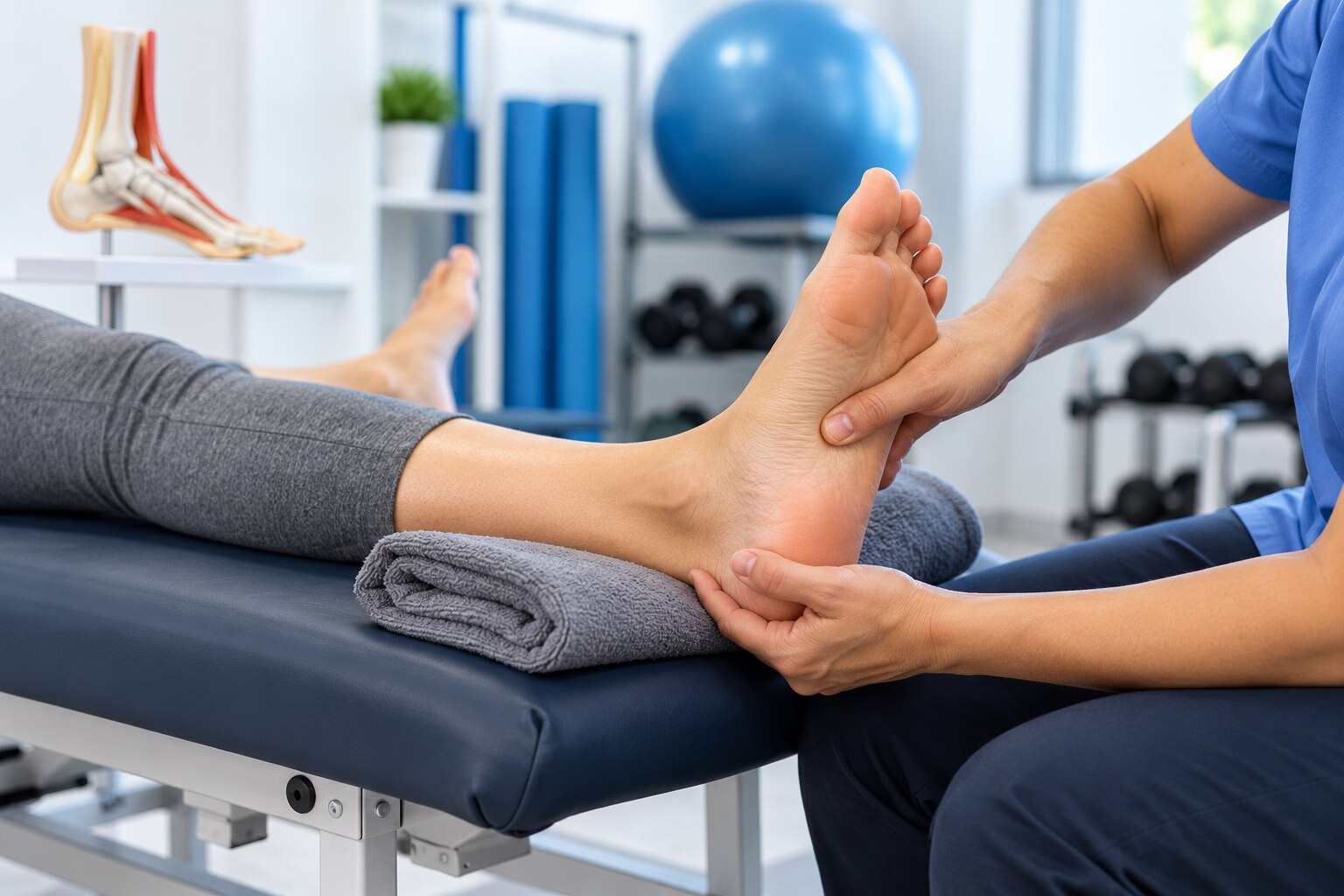
A foot rest can ease heel discomfort while you sit, but it does not rebuild the strength and tolerance needed for walking, work or sport. You will learn when to reduce activity, how to use a foot rest correctly, and when progressive physiotherapy is the better next step.
Key takeaways
- Choose relative rest, not complete inactivity, during a painful flare.
- Use a foot rest for comfort, not as a replacement for rehabilitation.
- Prioritise calf and plantar fascia loading in a progressive physiotherapy programme.
- Seek assessment when pain persists, worsens or limits normal walking.
Relative rest helps an overloaded heel; complete rest rarely solves the problem
If you are asking “plantar fasciitis physiotherapy or rest which helps more”, choose relative rest at first, then progressive rehabilitation. Reduce running, jumping, long standing and any other activity that clearly increases heel pain, but keep walking and normal movement within a tolerable level.
Complete inactivity calms loading temporarily but does not rebuild the calf and foot capacity needed for work, sport or comfortable daily walking.
| Option | What it does | Main limitation |
|---|---|---|
| Relative rest | Reduces aggravating load while preserving tolerable movement | Pain can return if activity rises too quickly |
| Complete rest | Removes most weight-bearing for a short period | Does not restore strength or load tolerance |
| Physiotherapy | Doses stretching, strengthening and a gradual return to activity | Requires regular home exercises and review |
A footstool or soft foot rest can make the heel feel better during a flare by removing pressure. Elevate the foot only enough to feel comfortable, use it for 15 to 30 minutes, and avoid treating that comfort as healing. Elevation does not correct reduced calf strength, stiff ankle movement or poor tolerance to loading.
Stop or modify an exercise if pain becomes sharp, alters your walking, or remains worse the next morning. Seek assessment instead of assuming plantar fasciitis if you have burning, numbness, marked swelling, night pain, fever, pain after trauma or difficulty bearing weight.
These signs can indicate a stress fracture, nerve problem, fat-pad injury or another condition requiring different care.
How to use a foot rest without mistaking comfort for treatment
A foot rest for plantar fasciitis reduces pressure on an irritated heel while you sit, so it can make symptoms feel calmer. It does not repair the plantar fascia, increase calf strength or prepare your foot for walking, running or standing.
Set up a foot rest for plantar fasciitis as a short comfort break, not a treatment session:
- Use a firm stool or cushion about 10–15 cm high, or choose a height that supports your whole foot without forcing your knee straight. Keep the heel supported rather than hanging over the edge.
- Elevate the foot for 10–20 minutes after prolonged standing, walking or another activity that aggravates pain. Keep the ankle relaxed; do not pull the toes upward throughout the break.
- Return to tolerable movement afterwards. Avoid using the foot rest to remain completely inactive for hours, because prolonged unloading reduces the strength and capacity needed for recovery.
- Reduce running, jumping and long periods of standing if pain increases during the activity or is worse the next morning. Replace them temporarily with tolerable walking and your prescribed exercises.
Putting your foot up may ease pressure or throbbing, but elevation does not correct the load-related cause of plantar fasciitis. If you need the rest repeatedly just to manage ordinary walking, assessment and progressive rehabilitation are more useful than comfort alone.
What a useful physiotherapy programme should include
A useful programme combines diagnosis, symptom control and progressive loading. The clinician should check whether plantar fasciitis explains your pain rather than assuming every sore heel has the same cause. They should also record functional measures such as first-step pain, walking time, heel-raise capacity and work or running tolerance.
| Approach | What it does | What to expect |
|---|---|---|
| Foot rest or complete rest | Removes load without building capacity | Short-term comfort, but weakness and reduced tolerance if prolonged |
| Passive treatment alone | May ease symptoms during or after an appointment | No reliable progression back to walking, work or sport |
| Progressive rehabilitation | Strengthens the calf and foot while restoring tolerance | Gradual improvement in function, not instant pain relief |
A well-designed home programme usually includes:
- Plantar-fascia-specific stretching: pull the toes back until you feel tension along the sole, holding 20–30 seconds before your first morning steps and after sitting. This is different from a general calf stretch.
- Calf strengthening: begin with supported double-leg heel raises, then progress towards single-leg raises as symptoms allow.
- Foot-control exercises: practise maintaining the arch during standing, walking and controlled heel raises rather than relying only on towel-scrunch exercises.
- Graded activity: reduce running, jumping and prolonged standing, then add duration or intensity in small steps while monitoring next-morning pain.
- Review and adjustment: the clinician should change exercise load when walking tolerance, first-step pain or heel-raise strength stops improving. Machines can support comfort, but they should not replace this progression.
How physiotherapy compares with shoes, orthoses, splints, medication and shockwave therapy
Judge plantar fasciitis treatment options by what problem they address, how long you can use them, and whether they restore walking capacity rather than merely dulling pain.
| Option | Main benefit | Limitation or best use |
|---|---|---|
| Physiotherapy | Builds foot and calf strength, improves flexibility, and teaches load management | Strongest as a progressive programme, not massage or machines alone |
| Shoes | Reduce pressure and improve comfort during walking | A better shoe cannot correct weakness or excessive training load by itself |
| Orthoses | Redistribute pressure under the heel and arch | Useful for selected foot mechanics; they work best alongside exercise |
| Night splints | Hold the ankle and plantar fascia in a lengthened position overnight | Consider them for persistent first-step pain; poor fit and sleep disruption reduce adherence |
| Medication | Can provide short-term pain relief | It does not rebuild tissue capacity; ask a clinician about NSAID risks and interactions |
| Shockwave therapy | Adds a treatment option for persistent symptoms after assessment | It should not replace diagnosis, load correction, or rehabilitation |
A practical comparison asks what you can do after four to six weeks: walk farther, stand longer, climb stairs, or return to training with less next-morning pain. Repeating passive treatments without measuring those changes wastes time.
Choose an assessment-led programme when symptoms persist, your activity demands are high, or the diagnosis is uncertain. Ask whether the clinician checks for nerve irritation, stress injury and Achilles-related pain, prescribes progressive home exercises, and adjusts activity as your tolerance changes.
A decision guide: when to rest, when to rehabilitate and when to seek assessment
Use relative rest for a new flare, then rebuild capacity; choose assessment sooner if walking is restricted, symptoms persist, or your activity demands quick, reliable recovery. Complete inactivity can reduce discomfort without preparing your foot for work, running or sport.
1. Rest from running, jumping, long standing and the specific activity that increases pain for several days. Keep easy, tolerable walking and gentle movement if you can do them without limping or a clear next-day increase.
2. Begin rehabilitation when ordinary walking is comfortable and symptoms settle within 24 hours after activity. Progress calf and foot strengthening gradually; a foot rest can provide short-term comfort, but it does not restore load tolerance.
3. Arrange an assessment if pain lasts beyond two weeks, repeatedly returns, or limits normal walking, work or sleep. Seek help earlier if your job involves prolonged standing or your training requires running, jumping or rapid direction changes.
4. Do not self-treat as plantar fasciitis after significant trauma, or with burning, numbness, marked swelling, night pain, fever, unexplained weight loss or pain at rest. These features can indicate a stress fracture, nerve problem, tendon disorder, inflammatory condition or referred pain.
If you search for plantar fasciitis physiotherapy rohini, ask whether the clinician checks alternative diagnoses, measures walking or activity tolerance, gives a progressive home programme and adjusts your load. Back In Motion -Dr. Sajal Agarwal -Physiotherapist should be judged by that assessment process, not by location or passive equipment alone.
Related services
Plantar Fasciitis Physiotherapy Treatment Plantar Fasciitis Physiotherapy Treatment Plantar fasciitis is a condition where the plantar fascia, a thick band of tissue that runs along the bottom of the foot, becomes inflamed and... View service → |
Focused Shockwave Therapy (FSWT) Focused Shockwave Therapy (FSWT) Focused Shockwave Therapy (FSWT) in Physiotherapy Advanced Healing for Musculoskeletal Pain and Dysfunction Focused Shockwave Therapy (FSWT) is a... View service → |
Frequently asked questions
Is rest or physiotherapy better for plantar fasciitis?
Use relative rest first by reducing painful loading, then progress to physiotherapy that restores calf, foot and ankle strength. Complete rest rarely solves the underlying problem.
Does a foot rest treat plantar fasciitis?
A foot rest can reduce pressure and improve comfort while you sit, but it does not strengthen the foot or address the cause of persistent heel pain.
What should physiotherapy for heel pain include?
A useful programme should assess your walking and loading, manage aggravating activities, improve calf and foot mobility, and add gradual strengthening.
How does physiotherapy compare with shoes, orthoses, medication and shockwave therapy?
Physiotherapy builds capacity through exercise and load management. Shoes, orthoses, medication and shockwave therapy can support symptom relief, but each has different benefits, limitations and suitability.
When should you seek assessment for plantar fasciitis?
Seek assessment when heel pain persists despite sensible activity changes, interferes with walking, keeps returning, or comes with marked swelling, numbness or unexplained symptoms.
Keywords